Visualiser des réseaux géographiques

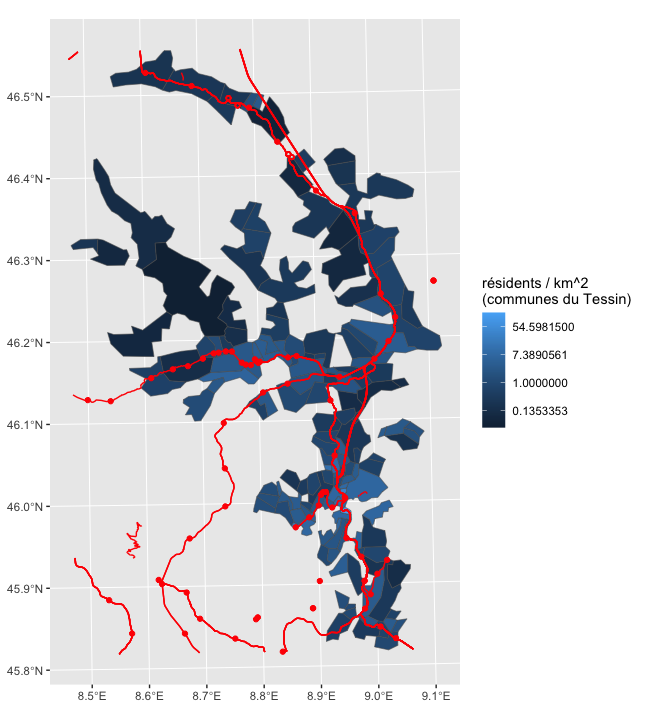
Les réseaux sont “l’autre” espace géographique, souvent négligés dans les approches classiques trop focalisées sur l’espace topographique des étendues euclidiennes des surfaces projetées du globe. Dans cet exercice, nous allons examiner comment les réseaux peuvent être formalisés sous formes de données informatiques et comment ces dernières peuvent être analysés visuellement.

La notion mathématique de graphe, vue en cours, est […] Continue Reading…

Between Art and Truth with Machine Learning

Robbie Barrat, image produced by a generative convolutional neural network trained on hundreds of realistical paintings.

What we call Artificial Intelligence reflects a thousand-year-old aspiration to provide thought with rules. It was born with the first cities, whose walls, selective doors, stairs, and secret passages gave new directions and meaning to human mobility. Four thousand years ago, a Sumerian scribe […] Continue Reading…

GéoRécits – an application for mapping journeys and lived spaces

GéoRécits allows you to map interviews pertaining to individuals’ mobility. You can compare individual travel journeys made by several individuals and leading to a common final destination – useful in the analysis of migrations – or analyse travel patterns accomlished for a given duration of time.

The two functions of GéoRécits

GéoRécits produces three types of diagrams based on […] Continue Reading…

Dymaxion world map with proportional circles and automatic legend in D3.js v5

The legend for proportional circles sizes is drawn automatically.

Reprojectiong on the fly from WGS84 to the newly available AirOcean (Dymaxion projection) in D3v5.

Example data: number of political reports sent by Swiss embasies to Bern in all languages and in French specifically betwee 1920 annd 1960.

Basemaps are from here.

Running D3 version of this map is available here.
<!DOCTYPE html>
<meta charset=”utf-8″>
<style>
.states1920 {
[…] Continue Reading…

Cleaning up PDFs of pre-1990s scanned texts for text mining in R with Quanteda

Text sources are often PDF’s. If optical character recognition (OCR) has been applied, the pdftools R package allows you to extract text from all PDFs to text files stored in a folder. The readtext package converts the set of text files into something useful for Quanteda. Nevertheless, some cleaning is necessary before transforming your text into a useful  corpus. […] Continue Reading…

Visualiser des données avec Orange Data Mining

Cet exercice sert à vous introduire à la visualisation de données avec le logiciel Orange Data Mining développé par l’Université de Ljubljana. Ce logiciel de “programmation visuelle” vous permet de programmer un processus d’analyse sans écrire de code. Orange Data Mining permet à ce titre de se familiariser avec des concepts de traitement informatique de données. N’hésitez pas à […] Continue Reading…

Stacked histogram with bivariate colored bars in R

A histogram gives you counts of elements within spefic ranges of a variable, represented as bars. Sometimes, you want to see more than bars. The following code allows you to represent a second variable with a color shade:

library(ggplot2)
library(data.table)

# create an example of a table
d <- data.table(
slope = round(rnorm(50),50),
p = sample(1:50,50)/1000
)

# discretize continuous values
d$midp <- floor(d$p*100)/100
d$midslope <- floor(d$slope*10)/10
d$midp […] Continue Reading…

Cartographie avec R

Les instructions de ce document sont encore valables, mais l’univers des modules R a beaucoup évolué depuis 2016. Aujourd’hui, les principaux développements en matière de données vectorielles se sont détachés des 3 anciens modules documentés ci-dessous (sp, rgdal, rgeos) pour se reposer principalement sur le modules sf. Pour une version mise à jour de cet exercice, je vous recommande […] Continue Reading…

Visualiser des données avec R: barchart, boxplot, bubblechart 3D, histogramme, parallel coordinates, radar chart, stripchart

Cet exercice vous conduit à travers le processus de visualisation de données dans R. Il présuppose que vous connaissez déjà les bases de maniement de R et de RStudio.

Charger les données

Téléchargement

Téléchargez le fichier unine_exercice1.zip depuis le site du cours.

Décompressez le contenu de l’archive zip dans un dossier de votre choix, par exemple dans c:\\unine\cours\data sur un ordinateur Windows ou […] Continue Reading…

Why Map the Austrian Presidential Election in 3D

A peer-reviewed paper based on this short post is available here:

Ourednik, A. (2017). The third dimension of political mapping: exploiting map interactivity for a better understanding of election and referendum results. Cartography and Geographic Information Science, 0(0), 1‑12. https://doi.org/10.1080/15230406.2017.1295820

On December 4th 2016, Austrians will have to renew their Bundespräsidentenwahl. Up to now, there have […] Continue Reading…