Tag-Archive for » tourism «

Monday, February 20th, 2012 | Author:

Space tourists (2009) Christian FreiToday, the United States are celebrating the 50th anniversary of John Glenn’s orbital flight: three tours of the globe in less than five hours. To mark the occasion, Craig Russell of Space Operations Inc., would have liked to see the mission replayed, but relying on private means only, this time. We get his point, because times have changed since Mercury Atlas 6: power concentrates elsewhere, the resources needed to send men in orbit are no longer in the hands of Nation-States. The conquest of space is no longer a political issue; it is about business. Uunless we look at it differently, that is to say, unless we admit that politics themselves have another owner. A growing private sector is about to own the transportation infrastructure into the margins of our World. Nation-States are its future customers. Google Lunar X Prize promises $ 30 million to the first team capable of sending a robot to the moon without public funding.
100 km above the ground is the Kármán line, where the atmosphere becomes so thin that it no longer provides the required lift for aircraft. Beyond it begins the field of astronautics and orbital flight. From this altitude on, territories and their borders lose their relevance, too: we leave the airspace and enter a “pure space”, even less legislated as the ocean waters. The French philosophers’, Emmanuel Levinas’ fascination for orbital flight, at that time, leads mainly to this: to the possibility of conceiving a space devoid of the cracks of history, and of the logics of separation and deep-rootedness that Europe has barely paid for, such a heavy toll, in the first half of its century. “What matters perhaps above all,” he writes, “is having been able to leave the place. For one hour, one man existed outside of any horizon – everything was sky around him, or rather, everything was geometric space. A man existed in the absolute homogeneous space. ”
Levinas was not talking about John Glenn, though, but about Yuri Gagarin, and his Vostok 1, whose April 12th 1961 path around the Earth from Baikonur to Engels still leaves a narcissistic scar in the American sky. We do not celebrate the first orbital flight of humanity, today, but only the U.S. one. Gagarin, the Soviet saint, and his eyes filled with infinite solicitude, is still hanging in the corner of the cosmic izba, tucked in his spacesuit like in the gilding of an othodox icon.
The future of space travel, however, commits neither the Cold War, nor metaphysics. Russian Soyuz shuttles welcome American space tourists, providing what the language of economics now calls a “service”: to fall out of the atmosphere at 4g, to hover in weightlessness for a while and to glide to the ground, then, leaving behind the wastes of the dream. In the documentary Space Tourists (2009), the camera of the Swiss filmmaker Christian Frei accompanies Anousheh Ansari on board the International Space Station, where she stayed for 20 million dollars. Down by the cosmodrome, Kazakh scrap dealers roam the steppes in search for spare parts fallen off during the takeoff phases. They cook lamb soup in a piece of rocket. Larger pieces are used for shelter for the night. Here and there, you see a garden or a roof, ravaged by the fallout of cosmic exploration. As writes the journalist Nick Rodick, “forty years on from Neil Armstrong’s ‘one small step for man’, we are still waiting for the ‘giant leap for mankind’.”
Ansari was neither the first woman in space, nor its first tourist. Other contenders – the first non-governmental astronaut, the first teacher in space, the first journalist in orbit… – punctuate the titles of the media since the 1980s, until the arrival of the first official “tourist”: the multimillionaire Denis Tito. “Official” only, though, because who is a tourist if not as anyone who moves away from his daily territory, into an elsewhere, devoid of any logic of necessity or obligation? As such, there is tourism, already, in Gagarin’s feat.
Tourism, in all its forms, is a way of escaping the space-time grid of everyday life. Can masses rushed through airport security locks still be considered as such, by the way? They don’t escape anywhere. The holidays themselves are carefully beaconed, by the soft jingle of travel guides, by family demands, by the need to confirm, back to the office, that you’ve been away from all this. Orbital tourism, in this sense, seems the only way into a real elsewhere. For how long, though? UK carrier Virgin Gallactic has already sold over 500 tickets at $200000 aboard its SpaceShipTwo. So watch out: the planet itself is about to become a landscape, the perfect background for a group picture! Its sighting may remain reserved to the privileged, of course, as the Jungfraujoch railway in its infancy, but this is just the beginning, right? Subsequently, as with all progress, any woman or man will be able to explore the outer reaches of sublunar space. In this respect, bold commentators are almost as touching as the poet Mayakovsky in his Flying Proletarian in 1925. Hearing them, we almost forget that one thing: that good old wood, beneath us, our Carboniferous legacy – wood in the form of oil that we need to burn, still and always, to go anywhere.

Resources

Image: screenshot from Space Toutrists, a documentary film by Christian Frei.

Oberg james, 2012, “Private Spaceflight: Up, Up, and Away. This year, commercial spaceflight will really take off” in IEEE Spectrum, January 2012.

Roddick Nick, 2009, Sell-Out on the Final Frontier.

Joan Johnson-Freese, Brian Weede, 2012, “Application of Ostrom’s Principles for Sustainable Governance of Common-Pool Resources to Near-Earth Orbit” in Global Policy, Volume 3, Issue 1, pages 72–81, February 2012.

Tuesday, May 31st, 2011 | Author:
Touristic stay-times in Switzerland

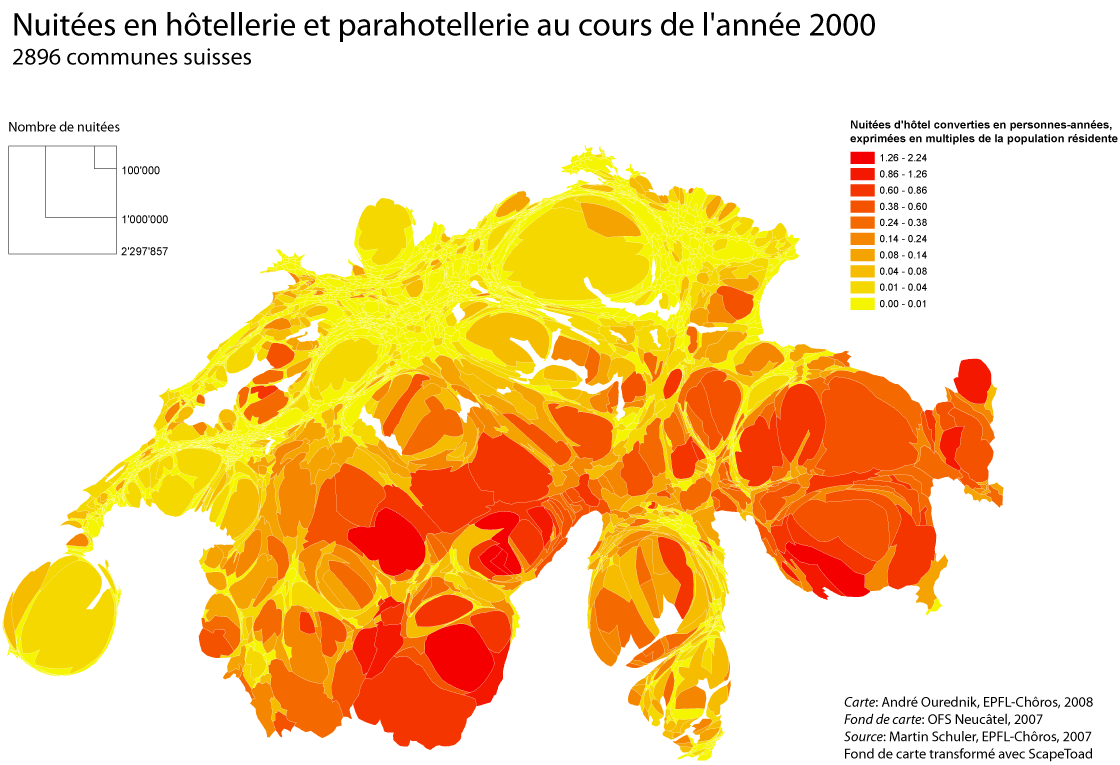
Hotel and para-hotel overnight stays in Switzerland in the year 2000. Total numbers and comparison do the residential stay-times.

Who’s the real inhabitant of a place? For a long time, population maps have been constructed as if everybody stood still in their homes. Yet leaving this “domostatic” perspective is to geography like opening Pandora’s Box. All objects of any concern to the discipline must then be understood in a dynamic relationship to the rest of the world. Because any spatially defined area in today’s globalized context is actually inhabited by more people than those that reside in this area, all individuals on the planet can be considered as a potential part of the population of any place. In other words, no place is local. A population map of any territory can only strive for accuracy if one tries to include global-mobility-induced stay-times within the mapped area.

To what extent this is true can be verified by looking at “imported” stay-times I’ve already talked about in a preceding blog . Here is another illustration, based on hotel nights. As you can see can see on this map, the touristic presence can sometimes up to triple the local population in terms of total stay-times, which shows not only the inaccuracy of domostatic measuring but raises also major political questions about “local” governance. In effect, to what extent can a place in which only one third of the actual occupants has political rights and obligations be considered as democratic? To which extent are local constitutions already concomitant with the principles of the World Tourism Organization? To which extent does the basic right to move, protected by the Article 13 of the Human Rights Declaration, need to be extended to the freedom to act, politically, in places other than one’s residence?

The place of the topographic territory in politics will need much thought and attention in the upcomming epoch. No doubt its importance will be both downscaled and coupled to other societal interobjects. The westphalian model of the territorial state is under rising pressure. New models of participation, based on transterritorial societies, will have to be invented, unless we want to see democratic systems turn into unpraticable reliques.

References

Ourednik André, 2010, “Cartografare in due dimensioni la realtà diacronica dello spazio abitato” in Emanuela Casti e Jacques Lévy (a cura di): Le sfide cartografiche. Movimento, partecipazione, rischio, Universtà degli Studi di Bergamo: il lavoro editoriale, pp. 65-77.

Tools

Excel, Spss, ArcGIS, ScapeToad, Illustrator.

Tuesday, April 19th, 2011 | Author:

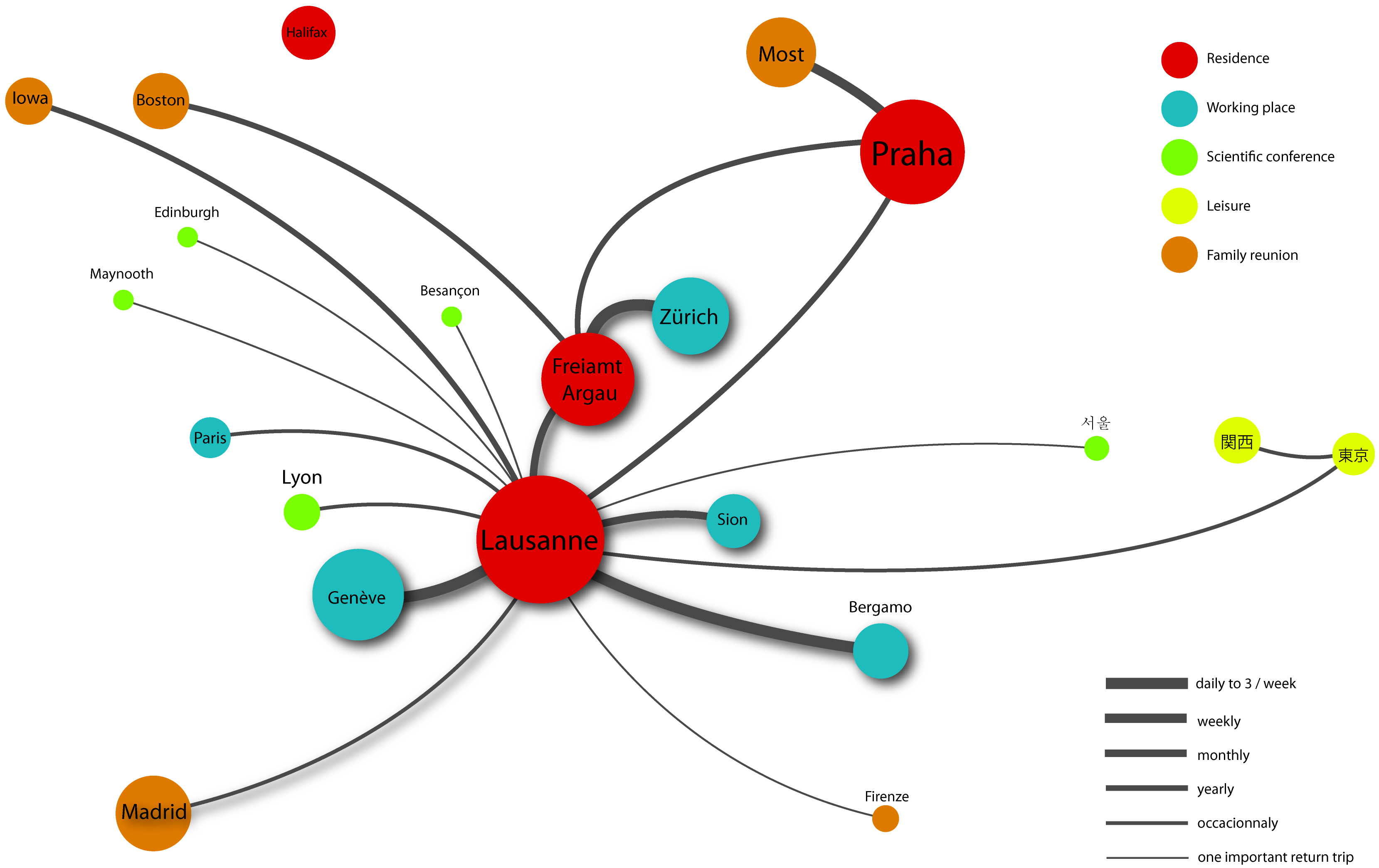
Lived space as a mapThis is a map by which I’ve presented myself to my students on the first day in a course on tourism and mobility. I’ve given it in 2010 at the Università degli Studi di Bergamo. I wanted to make two points by showing it:

  1. What a professor teaches is deeply rooted in who he is. You can only acquire sufficient critical distance to a taught theory by considering the person of the teacher, above all his personal history with respect to the examined acedemic matter. I’ve moved a lot during my life, partly because I wanted to, partly because I had to. And I’ve moved essentially in the Northern Hemisphere. All this has to be kept in mind when I speak about mobility.
  2. What an individual is is a unique composition of the relations of that person with other people, things, places,… Identity is connectedness and movement. It is rooted in a space composed by a plurality of places.

The map above gives a rich glimpse into these aspects; its cartographic protocol is simple, though: circle sizes represent relative stay-times, their colors the type of my relation with a specific place, the line lengths represent time-distances, and line thickness the frequency of travel. You will note that azimuatal relation of places respect their topographic distribution on the surface of the globe to some extent.

I did not use any formal data to represent it: it is a “free-hand” computer drawing. This is all the more legitimate considering that I am the subject of this map. It must be intersting to conduct the same spatial autoportrait experiment with subjects with no geographical training. The distribution of places will probably be very different in that case. The procedure is similar to the one used for the construction of Kevin Lynch’s mental maps; only that here, the time-dimension of the lived space gets the most significant part of attention, instead of landmarks and boundaries.

Tool: Illustrator.

Inspiration: The construction protocol of this map was inpired by the work on “self-extensive mapping” conducted by the SCALAB group, under the mandate of the Plan Urbanisme Construction Architecture (PUCA).

Wednesday, March 30th, 2011 | Author:

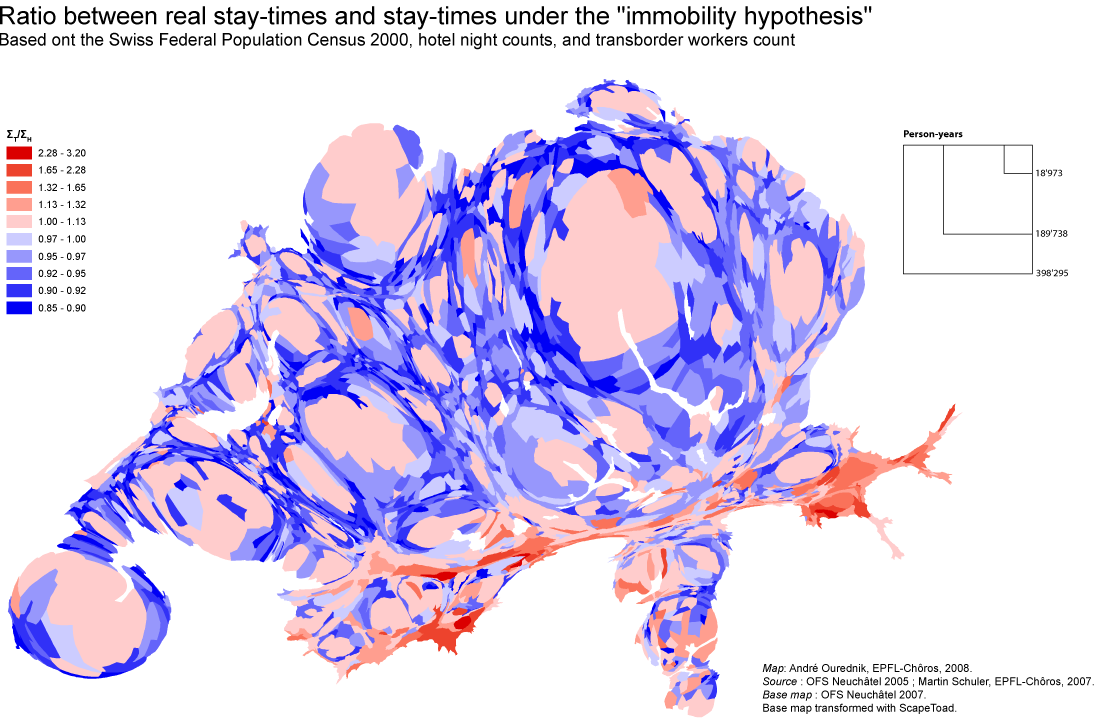
Ratio between real stay-times and stay-times under the "immobility hypothesis"Counting how many people reside at a given address might just not be enough to understand a territory of mobile individuals. Instead of counting people, I count their “stay-times”. In other words, I sum up the time spent by people in each place.

The map above compares two results:

  • ΣH, the hypothetical total stay-time which would have been registered if people never moved.
  • ΣT, the observed total stay-time,  calculated from data of the Swiss Federal Population Census 2000, the hotel night counts and the transborder workers counts.

Both ΣH and ΣT are calculated in minutes. If ΣH of a commune is divided by the number of minutes within a year, we get the residential population of that commune.

The ratio ΣT/ΣH makes it possible to identify communes whose “population” is under- or over-estimated by standard census counts. They also make it possible to identify attractors of mobility. In effect, red areas have a larger population than suggested by a residents-count, because time is spent in them by people residing in other communes. Blue areas, on the contrary, have a smaller population.

The lowest ΣT/ΣH-ratios are registered for peri-urban communes. Obviously, people who sleep in these actually live elsewhere.

The highest ΣT/ΣH-ratios are registered in the cantons of Valais and Graubünden mountain resorts. In most extreme cases, tourists triple their population. Urban centers have “only” up to 30% more dwellers then resident-counts would suggest, but their ΣT/ΣH-ratios are systematically positive.

These population differences are important for many reasons, among which infrastructure costs. Shouldn’t peri-urban regions contribute more to the financing of urban centers?

Spatial data resolution: Swiss commune.

Time-data resolution: minutes.

Data handling tools: SPSS and Excel.

Mapping tools: ArcMap, ScapeToad (for the anamorphosis) and Illustrator.

Monday, March 28th, 2011 | Author:

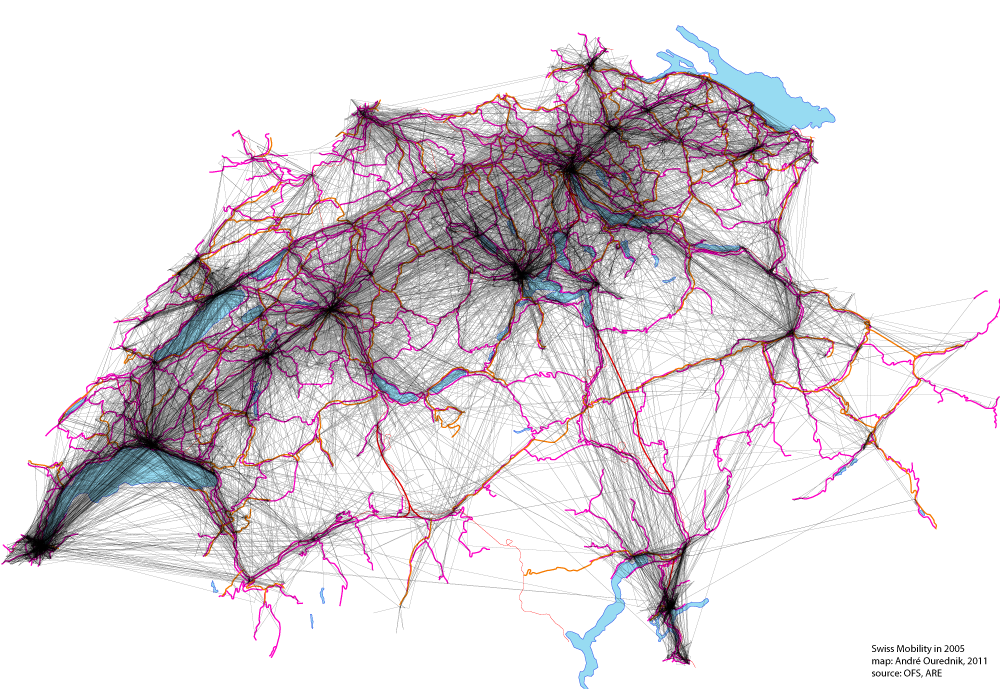
Mobility on Switzerland in 2005 (André Ourednik 2010)This map shows all movements made by Swiss citizens questioned on their traveling practices in the “Mikrozensus zum Verkehrsverhalten 2005“. 33’390 people have been asked. The map includes trips made for the purpose of work, study, leisure and household matters.

Material infrastructures, like roads and railways, are shown too, in pink and red, but they are not the main point here, with the respect to the question of mobility. What really moves and, by moving, makes relations between places effective, are the travelers themselves. Places are primarily linked by those who move between them.

Recorded movement between any two places is shown in black transparent lines. Transparency is essential here, as overlapping generates darker regions, revealing main mobility network nodes.

Observations

The star-shaped nodes coincide with large cities, both sources and attractors of travel. The city of Luzern appears as one of the largest – surprisingly so, because it is relatively small in terms of residential population. Luzern is an important touristic attraction, though, which explains its centrality in terms of mobility.

Note also the coincidence, between actual movements, and the density of the transportation network (railroads and roads are shown in red and pink). Where they don’t coincide might be a sign of suboptimal – or subefficient – territorial planning. One might ask, for instance, whether it was really “necessary” to build the Lötschberg Base Tunnel… Analyzing mobility data from 2010 might at least tell us whether the construction of this link had any effect on the individual mobility structure.

Tools

Mapping tools: ArcMap, Python script, Illustrator.

Trick: transparency has been applied to straight lines to accentuate main nodes and to prevent rare connections from covering the picture.