On November 5th, 2026, I’ve enjoyed an inspiring public discussion we had with
- Michael Herzog, Professor in behavioral and cognitive neuroscience, EPFL
- Amir Zamir, Professor in AI and machine Learning, EPFL
- and myself, lecturer in the SHS program at the EPFL, with a perspective rooted in the humanities and social sciences
Moderated by Anne-Laure Gannac, from the Swiss Radio and Television (RTS). As in any goode debate, we disagreed on many aspects of the question of consciousness and converged on others. From my perspective of philosophy and geography, consciousness manifests itself at multiple scales, from the Planck scale (as in Orch OR theory) to the planetary Earth scale, where consciousness is mediated by language and images. Let us start with two examples that illustrate the latter scale.
Two geographic examples of consciousness
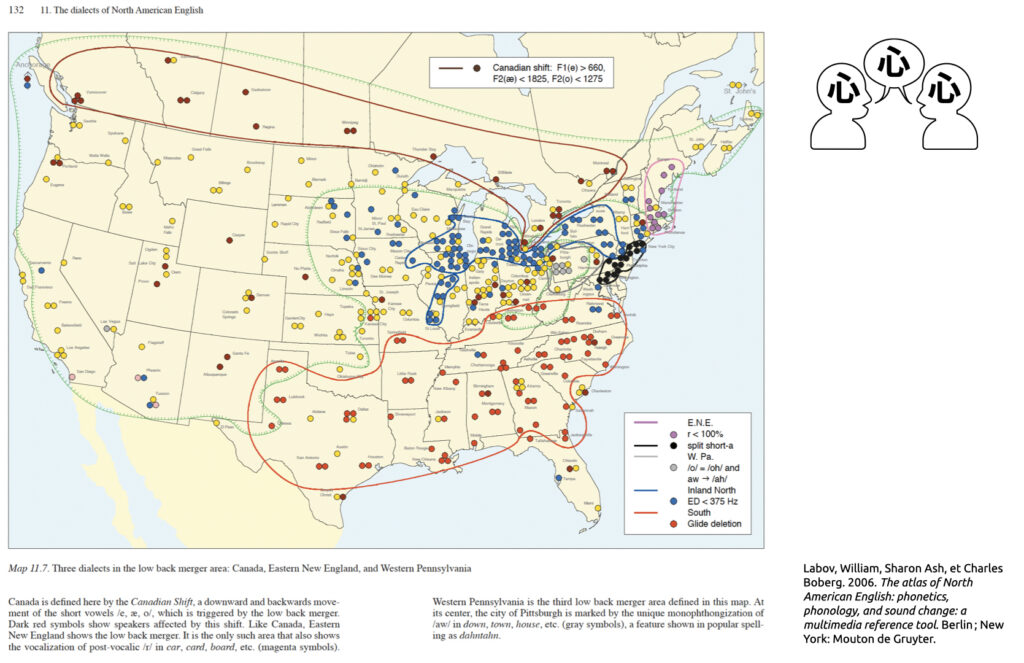
My first example… looks like a weather map, right? In some sense it is one, since we are dealing with an atmospheric phenomenon called “sound waves”. Specifically, it shows the diffusion of phonema of Northern American English, i.e., of the way how Northern Americans pronounce the short vowels /e, æ, o/. The medium of propagation of phonema, like of any other sound, is the air. But not only. Since they enter people’s ears, are processed in the brain, and than come out again of the people’s mouths in the form of spoken language. This is, obviously, a spatially constrained process, and that’s why we have regional accents. I’m showing this map to remind us how much our environment shapes our language. How language takes shape on a supra-individual level, prior to shaping our consciousness.
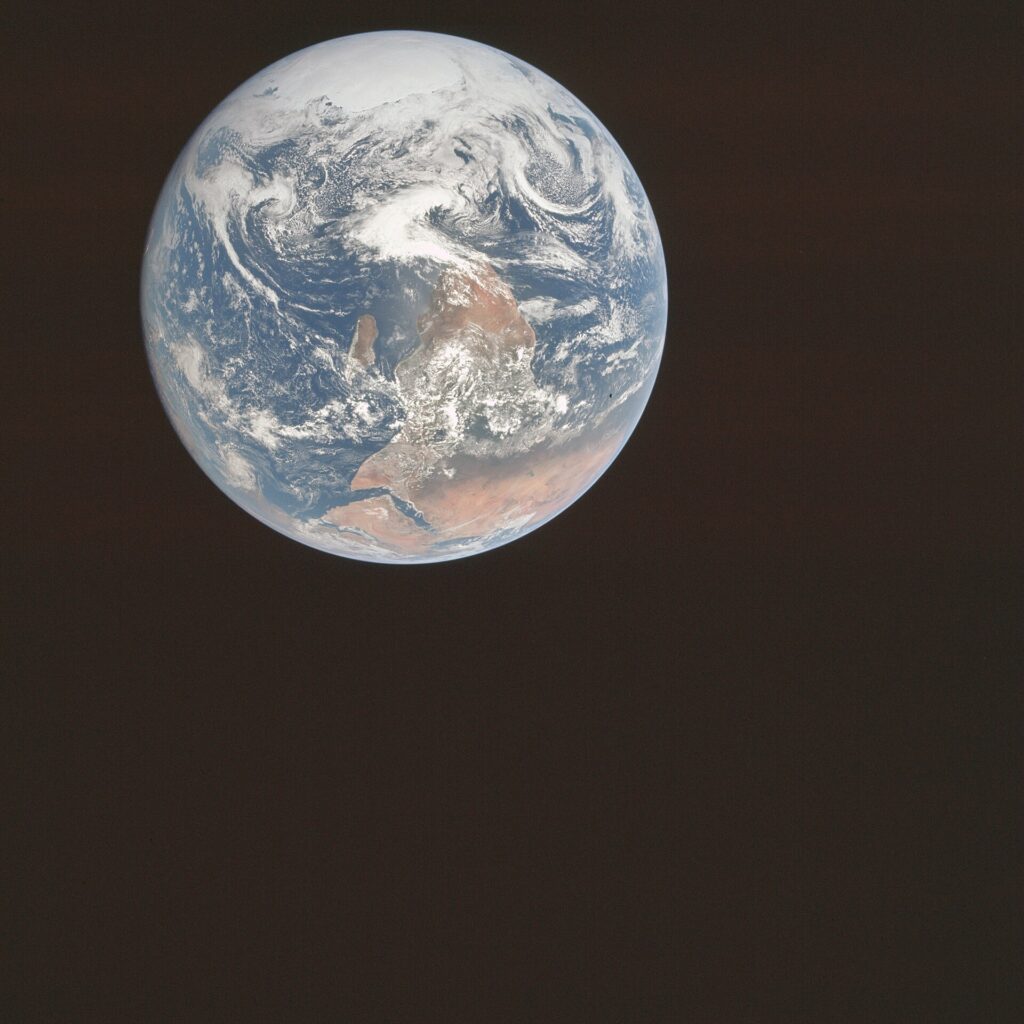
My second image is this old photograph of Earth, also known as the Blue Marble ». It only exists thanks to engineers, since it was taken by the Appollo 17 space shuttle, in 1972. The cultural relevance of this image is that it has greatly participated in the emergence of an environmental consciousness in the 1970s. Of the collective consciousness of the fact that we are living on a small planet with limited resources. The reason I’m showing you this photograph is to illustrate that consciousness relies on mediation. External objects, like photographs, help us in becoming aware of our situation. So they fully take part in the process of consciousness. In the process of becoming conscious of our shared reality.
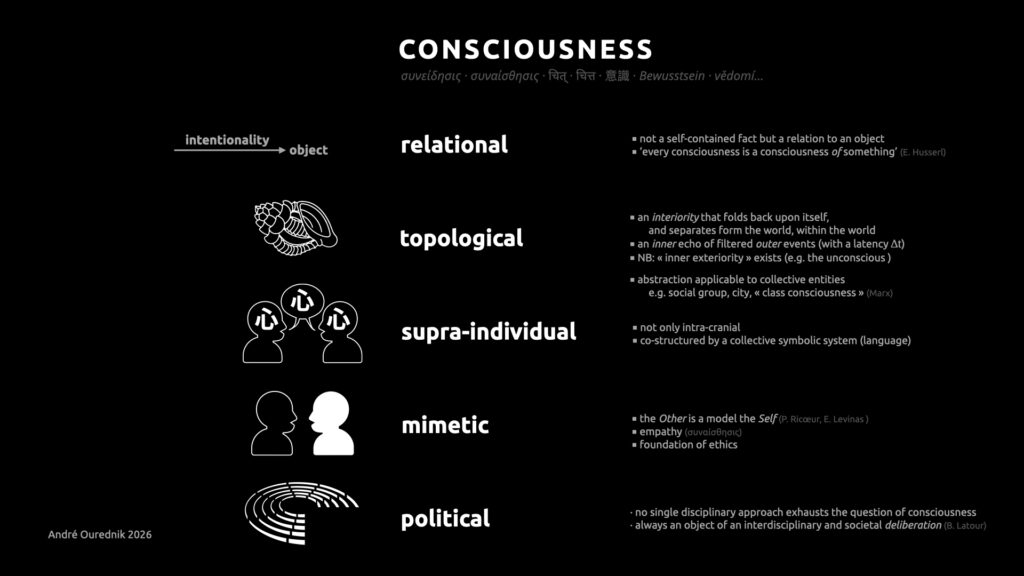
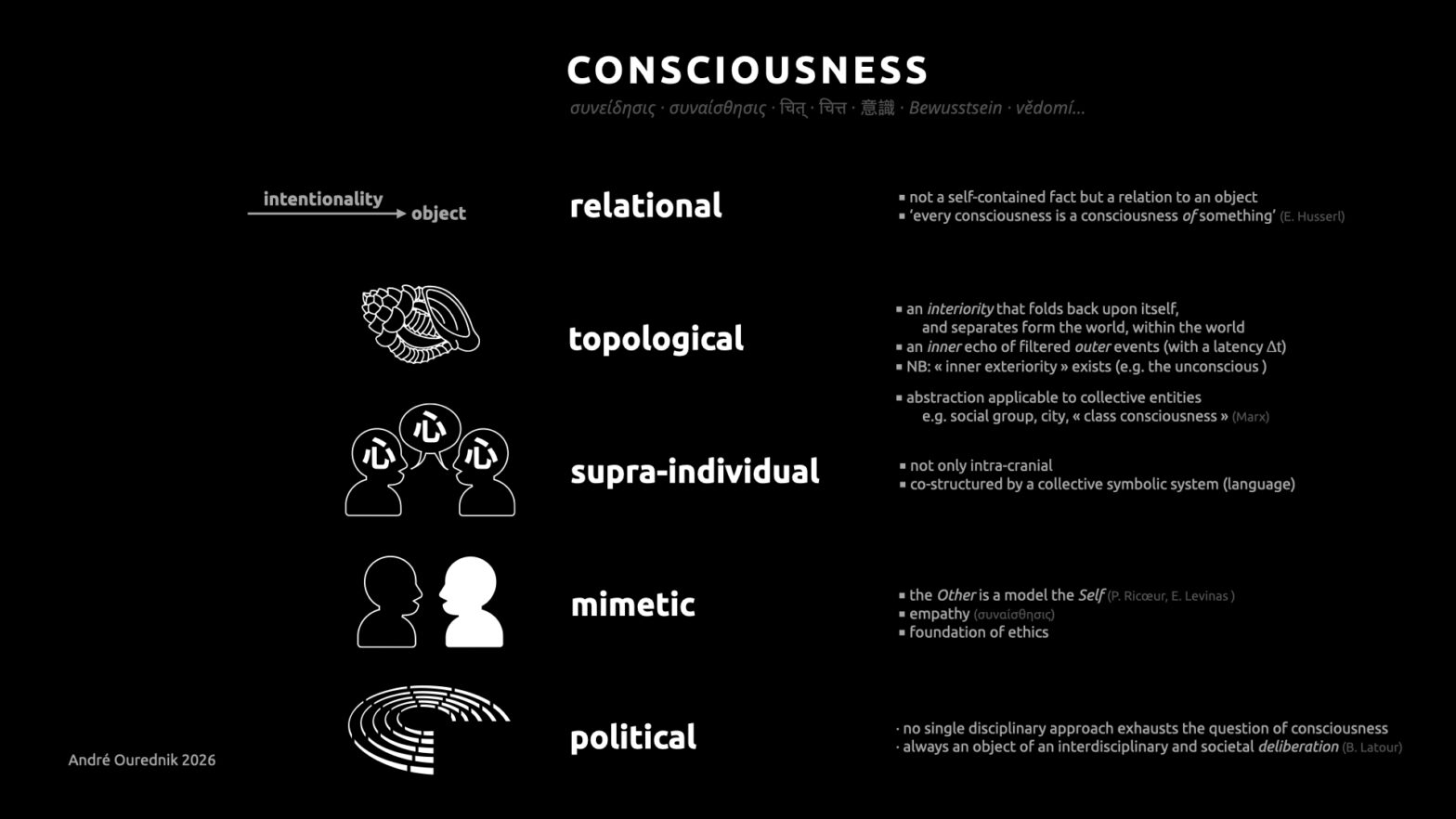
But let’s proceed to a more formal set of definitions and aspects of consciousness. Operational definitions, that allow us to work with the concept of consciousness in a social science like geography. In this framework, consciousness is relational, topological, supra-individual, mimetic and political.
Relational
It is relational because it is not a self-contained fact, but always a relation to an object. ‘Every consciousness is a consciousness of something’.
Topological
Consciousness is a topological phenomenon. First, simply, as a separation between an inside and an outside. It is a subregion of the world, that folds back upon itself. Thus becoming an interior that separates itself from the world, within the world. We can use an acoustic metaphor, here, saying that consciousness is an inner echo of filtered outer events, with a certain latency (Δt). Just note that an « inner exteriority » exists, e.g. the unconscious.
This topological description of consciousness might seem very abstract, at first, but it is heuristically useful. Since it allows us to speak about collective entities, such as cities, or social groups. Much as an ethologist would talk about the consciousness of a beehives. In the sociological vocabulary of Karl Marx, for instance, you have the notion of « class consciousness ».
Supra-individual
This leads me to the next point consciousness is supra-individual, as it is never only intra-cranial. This means that trying to understand consciousness by looking only at the brain would be like trying to understand all of astrophysics by looking only at black holes. You have to be aware of all the multiple scales at which the phenomenon manifest itself. And, beyond the brain, consciousness is co-structured by a collective symbolic system, notably by language.
Mimetic
Consciousness is mimetic, because the other person is also a model of your self. In logical terms, you understand yourself as an instantiation of the same class as the Other. You understand yourself by observing the Other, as someone who experiences fear, joy, pain, pleasure… This is the prerequisite for the generalisation of any neurological or psychological experiment. And because you consider the other as a form of consciousness similar to yourself, you experience empathy (or the other way around). And this is the very foundation of ethics. This is also why AI can have no inherent ethics, as it does not experience empathy.
Political
Finally consciousness is political, because it is a political object of inquiry. It is normative and legal. It definition decides who or what has moral agency, or rights (AI systems, animals, brain-dead patients…). Therefore, no single disciplinary approach exhausts the question of consciousness. Consciousness is always an object of an interdisciplinary and societal deliberation. And as such a political object.
To go deeper, you can watch our full debate on the “EPFL humanités et culture” channel on YouTube:
Other resources
- Ourednik, A. (2024). Robopoïèses. Les intelligences artificielles de la nature (2e éd.). La Baconnière.
- Ourednik A. (2025). Robopoiesi. L’intelligenza artificiale della natura (A. Pitozzi, Trad.). Il Saggiatore.
- Herzog, M. H., Schurger, A., & Doerig, A. (2026). Scientific theories of consciousness. Cambridge University Press.
- Ourednik, A. (2017). Omniscience. La Baconnière.
- Ourednik, A. (2025). Robopoiesen. Die künstlichen Intelligenzen der Natur und LLM-Chimären. Volltext, (1/2025), 30‑38.
- Ourednik, A. (2019). Hypertopie : De l’utopie à l’omniscience. La Baconnière.
- Ourednik, A., Koller, G., Fleer, P., & Nellen, S. (2018). Feeling Like a State. The Sentiments-tide of Swiss Diplomacy through the Eye of the Algorithm. Administory. Zeitschrift Für Verwaltungsgeschichte, 3(1).
- Ourednik, A. (2010). L’habitant et la cohabitation dans les modèles de l’espace habité [Thèse de doctorat]. École polytechnique fédérale de Lausanne.