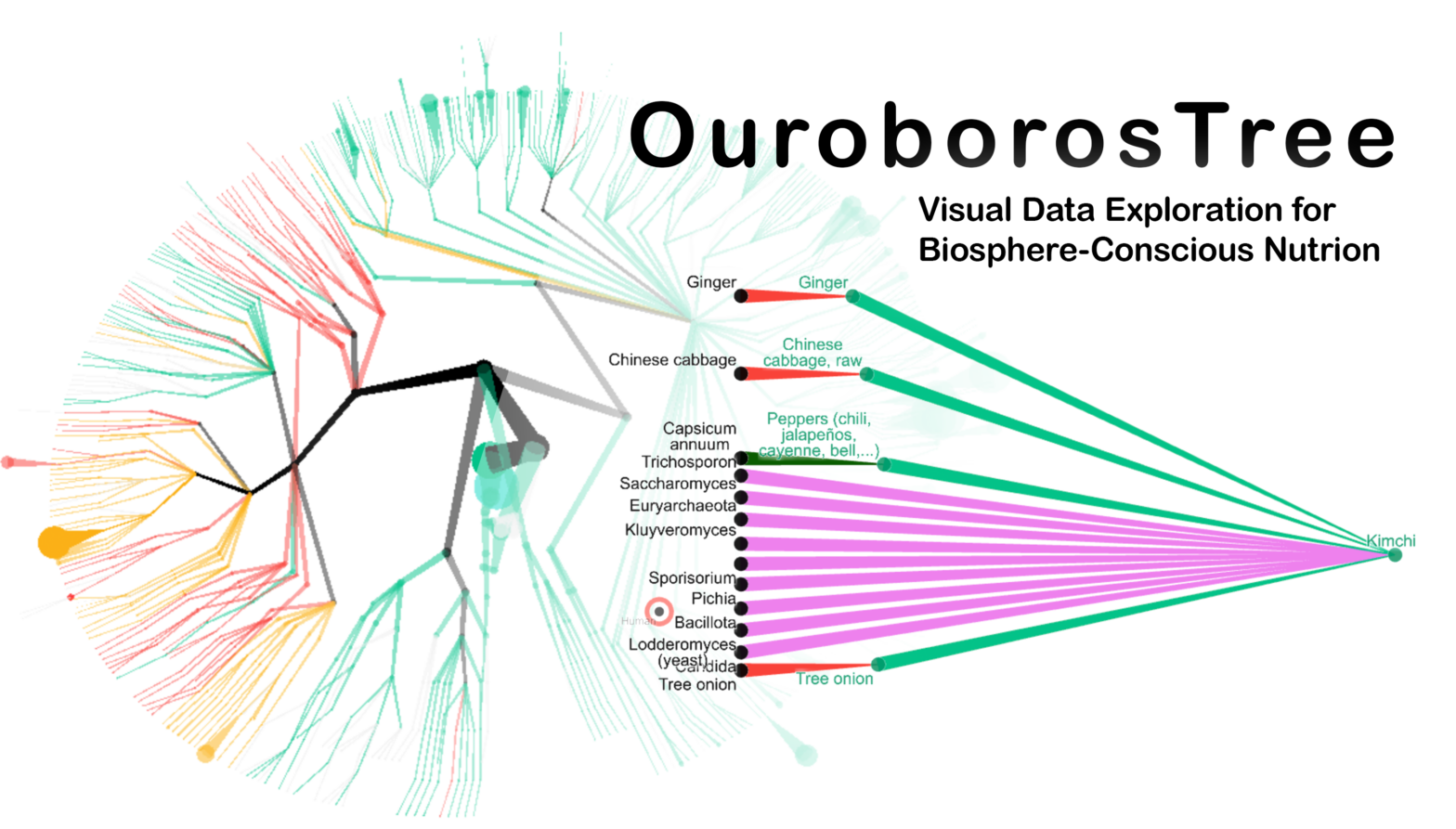
OUROBOROS TREE is a visual application for exploring relations between human nutrition and living organisms. I have built it because many contemporary issues can be addressed through a prism of our relationship with “non-humans” (according to Bruno Latour’s terminology). The project is evolving and welcomes feedback from the public.
OurobosTree harmonizes, for the first time, environmental and nutritionist data from NCBI Taxonomy (via Uniprot.org), FAOSTATS, the Swiss Food Composition Database, the IUCN Red List of threatened species, Wikidata and the GutFeeling KnowledgeBase (GFKB).
I have also associated over 23’000 open license images from Wikimedia and iNaturalist with individual taxa.
This project is under ongoing development. Contact:
for collaboration or integration of OuroborosTree in your project.
Special thanks
A great thanks to Jelena Ristic for the wonderful conversations and reflections that have led me through many philosophical, ethical and scientific challenges of this development! Part of this project has enjoyed the financial support of the Alimentarium Museum in Vevey. Great thanks to Nicolas Godinot for his cordial and open-minded management of our collaboration ! This project’s concept, data and prototype served as a base for the installation of ‘Galaxy of Edibles’ by Kirell Benzi in the museum; his cables.gl port and extra developement has been adapted to the museum’s specific needs. Many thanks, Kirell, for the inspiring discussions about cables.gl.
Tree View

The phylogenetic tree view allows the exploration of edible taxa organized by branches of the “tree of life” (contemporary division by kingdom > phylum > class > order > family > genus > species). You can highlight the tree’s branches based on parameters that play a role in the food choices of individuals and societies (diets, allergies…). Color codes identify taxa (tree branches) that the diet allows, or not, to consume.
Things to try
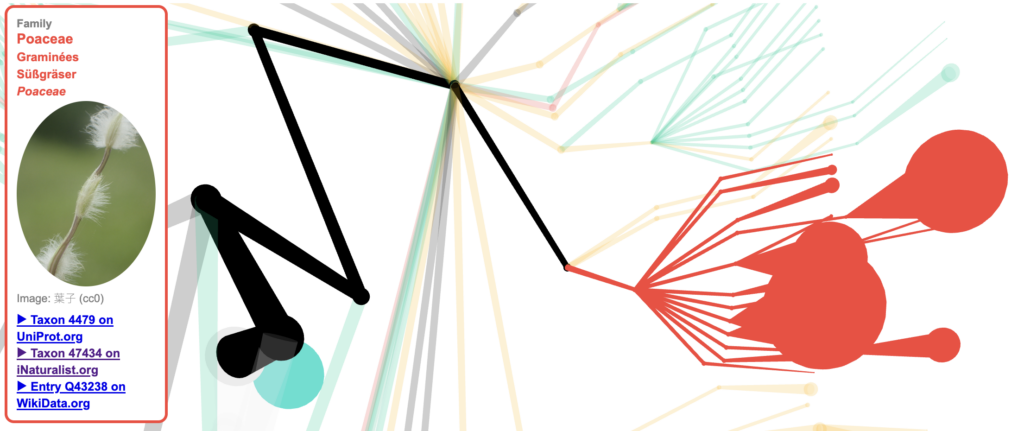
Observe how a diet distributes across the tree. Ketogenic diets, for instance, forbid all descendants of the Poaceae family. Halal and Kosher diets forbid insects, but allow eating honey from bees.
Try combinations such as “Halal and Ketogenic”. Click on the nodes of the tree to see illustrations and further information.
Conceptual limits
In religous cases (halal, kosher) choosig the “right species” is necessary but not enough. While fish with scales and most sea food, for instance, are, in principle, halal, the ritual must be observed for terrestrial animals. Meat from kosher mammals and birds may not be cooked or eaten with dairy; utensils and preparation must be separate, and many communities observe waiting periods between meat and dairy. Specific religious days and periods thoughout the year also exclude some food sources.
Network View
The network view explores the links between:
- taxa of living organisms (species, genus, phylum…),
- primary edibles they make or are killed for (fruits, meat), and
- complex edibles composed of other edibles, in other words, recipes (“Berner Platte”,”Czech Potato Salad”,…).
Click on the nodes of the network to see illustrations and further information. There are six types of relations between the network nodes:
— Makes
Individuals of this taxon make edibles (eggs, fruits). European hazel trees makes hazelnuts. Olive trees make olives.
— Is Used to Make
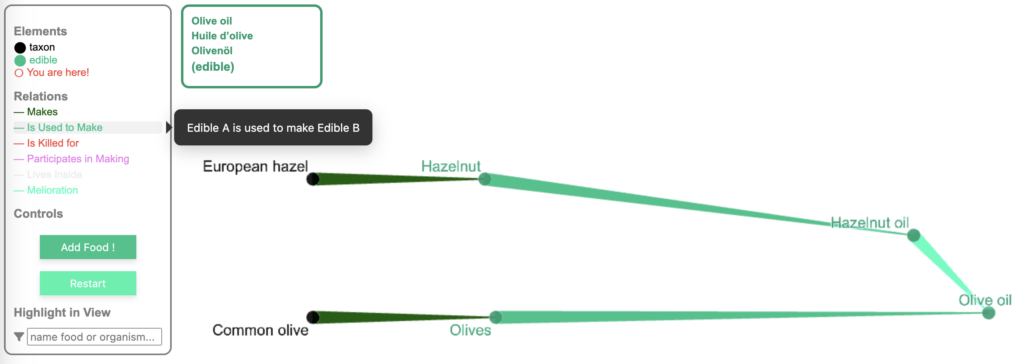
Edible A is used to make Edible B. Hazelnuts are used to make hazelnut oil. Olives are used to make olive oil.
— Is Killed for
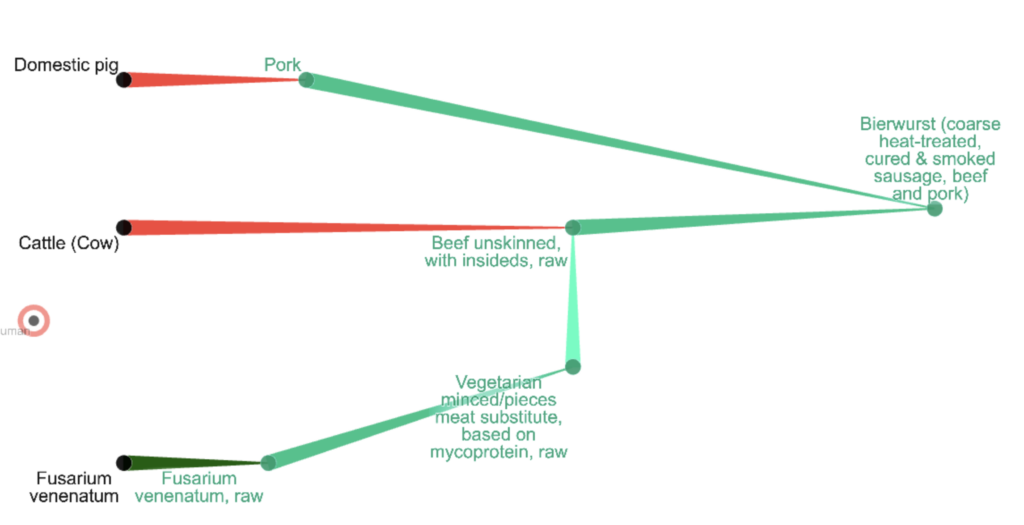
Living individuals of this taxon are killed to turn them into edibles. A pig and a cow are killed for bierwurst. Unless they are replaced, that is, with a vegetal alternative.
— Participates in Making
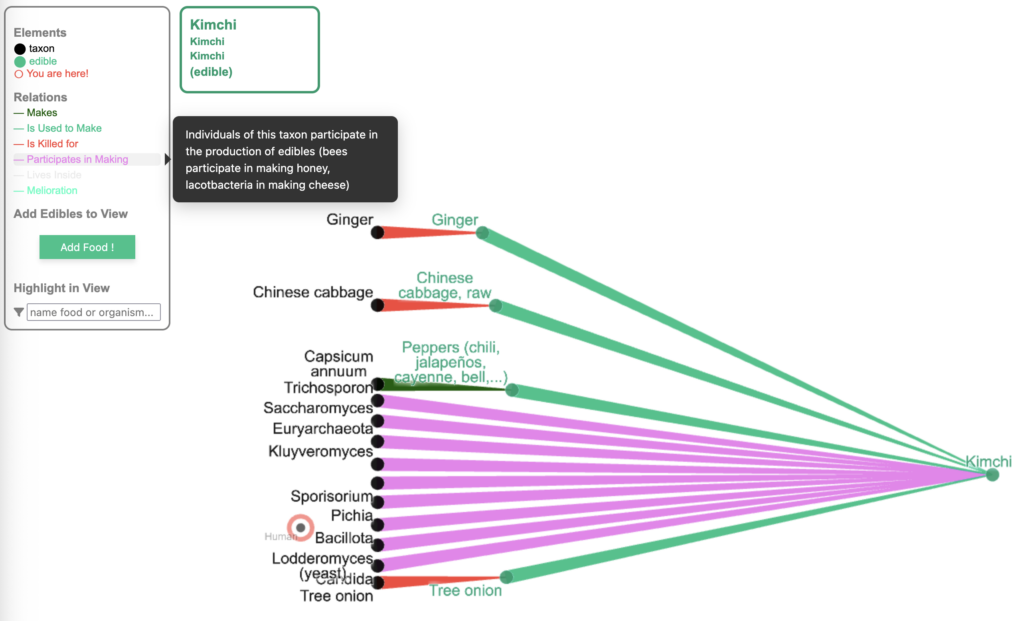
Individuals of this taxon participate in the production of edibles. Bees, for instance, participate in making honey. Lacotbacteria in making cheese, or fermented foods like kimchi.
— Lives Inside
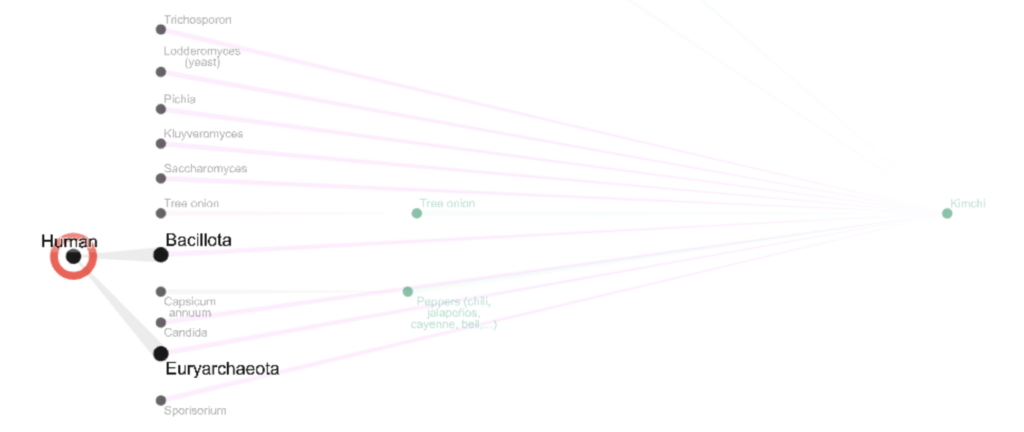
While the stomach is acid, many bacteria are acid-resistant. When we eat foods that contain them – such as fermented foods – they make their way into our intestines and remain there to live. Eating fermented foods like kimchi can significantly increase the diversity of your gut microbiome. This is helpful in many ways. There are fewer resources (like sugars and space), for instance, left for harmful pathogens like E. coli or C. difficile. Gut bacteria also produce or stimulate neurotransmitters like serotonin, which contributes to mental health.
— Melioration
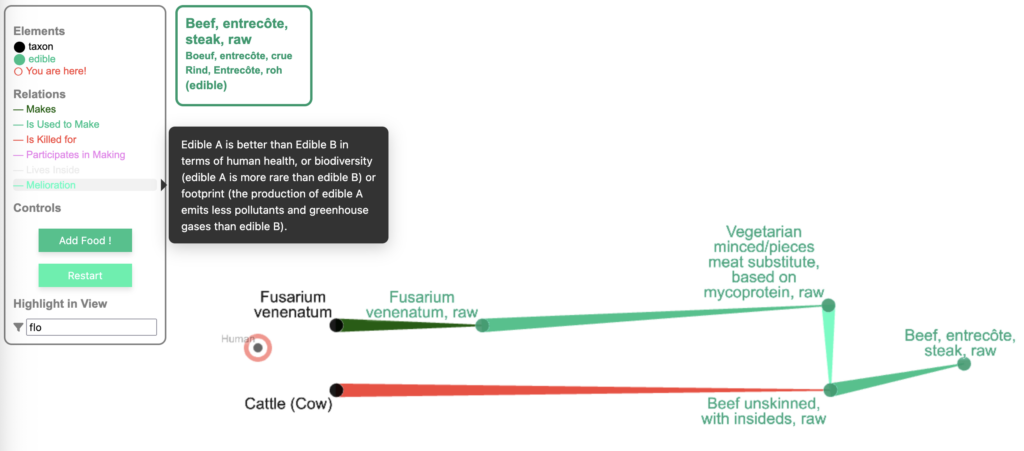
Edible A is better than Edible B in terms of human health, or biodiversity (edible A is rarer than edible B) or footprint (the production of edible A emits fewer pollutants and greenhouse gases than edible B). Some substitutions are easy, others trigger questions. e.g. you can replace fine-grained flour with coarse-grained, but can you still bake the same sweets?
Notes and FAQ
Why not show images of prepared foods?
Almonds do not produce almonds – almond trees do. And how many of us have actually seen an almond tree? Images of prepared foods saturate the imaginary of citizens in industrialised societies, but we have only rare occasions to see the actual living organisms that make them possible. Thus, I focus on open licensed photographs and illustrations of these organisms. Each of these images also attests of a concrete encounter between them and a human being (the photographer, the illustrator).
Does the app give access to all 23’000 images of organisms?
Both views of the visual application give access to 5% of open-licensed (CC-BY, CC-BY-SA, Public Domain) Wikipedia and iNaturalist images of biological taxa I’ve identified and gathered, as for their relevance for human nutrition. These images can be reused in any non-commercial or commercial context. The full list of image URLs can be obtained on demand from me.