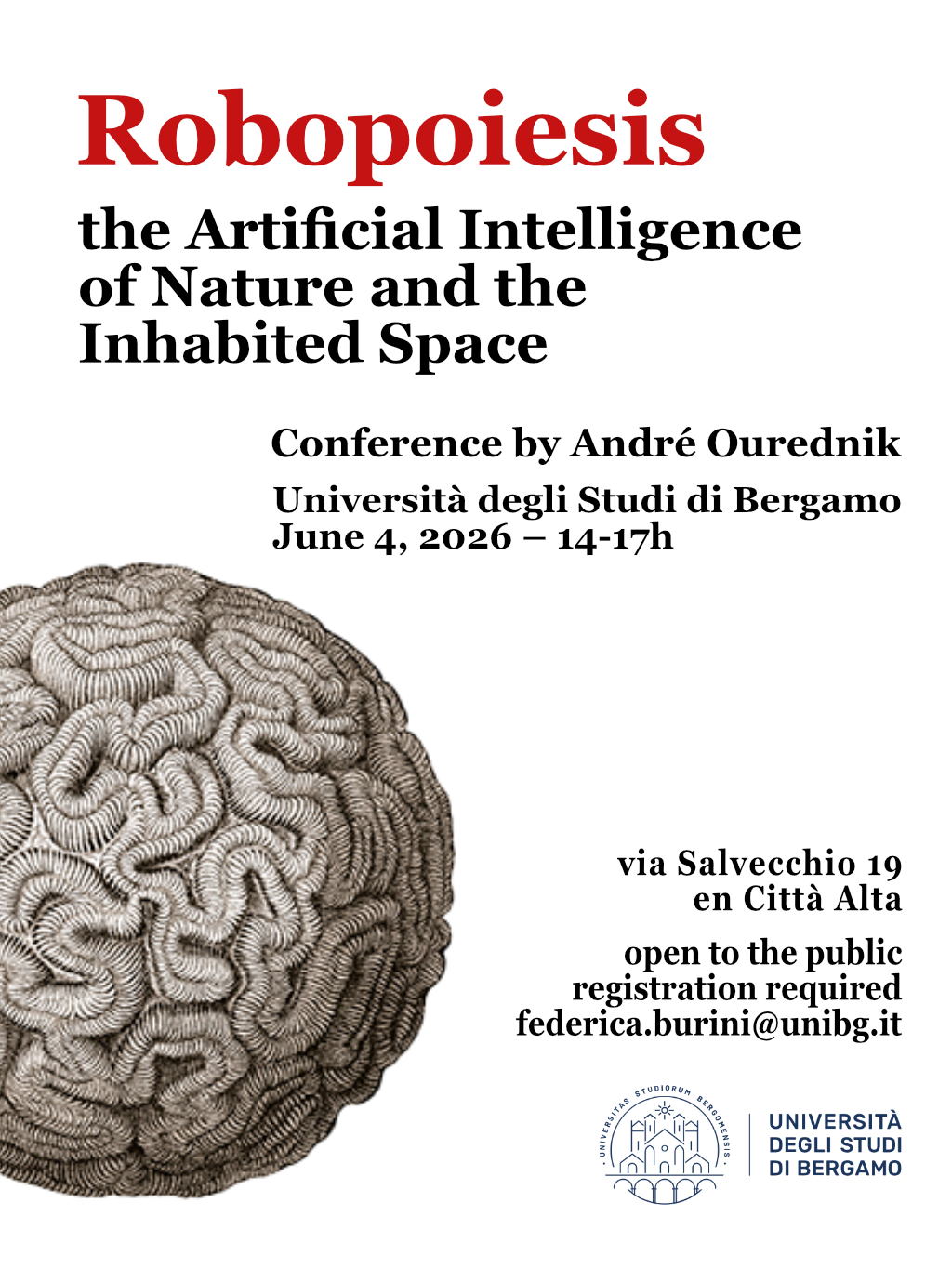
Robopoiesis: the Artificial Intelligence of Nature and the Inhabited Space

|
June 4, 2026, Robopoiesis: the Artificial Intelligence of Nature and the Inhabited Space. Università degli Studi di Bergamo.
14:00-17:00 - Stanza 7 Project Work, via Salvecchio 19, en Città Alta Open to the public, registration required. Mail to federica.burini@unibg.it The lecture will explore André Ourednik’s reflections on AI with regard to the inhabited space exposed in Robopoiesi. L’intelligenza artificiale della natura (Il Saggiatore, 2025). How should we understand the terms “nature”, “artifact”, “intelligence” and “artificial intelligence” in this context? How does AI manifest itself in language and in built environments. How do these spaces relate to “nature”? What roles does AI play in the context of an environmental crisis? What are its implications for the practice of spatial planning at multiple scales and its relationship with political processes? We will provide examples ranging from past forms of artificial intelligence to current applications of analytical and generative machine learning, multi-agent models and parametric approaches. Specifically, the lecture will address:
Related publications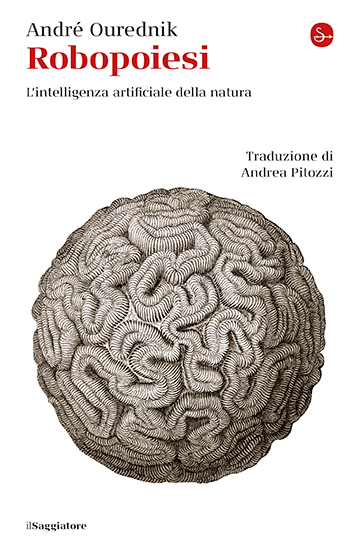
In one image
|