Archive for the Category » Maps «

Saturday, February 23rd, 2013 | Author:

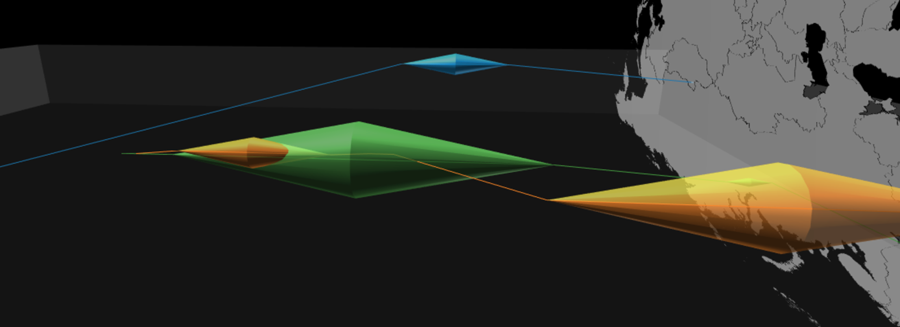
Timeline of the Universe (Source: NASA/WMAP science team)

A cosmology is the science of the human position in what the Greeks called the cosmos: an ordered universe in space and time. The Greek word cosmos also means army.
Even our physicists still conceive cosmoi, and make maps of them. One of these maps shows a universe unfolding in time like a living being. A continuous succession of planes, from left to right, illustrates its expansion and its successive states, over a period of about fourteen billion years.  The first plane, on the far left of the map, is reduced to a point. The following plane has a significantly expanded scope; we understand that a bang took place. Colors abound in the area, with red, yellow, bluish and turquoise tints. Then the lights go out. A silence of a half a billion years befalls the universe. In the next plane, a light mist appears again, this time white. Stars are isolated, they condensate, the expansion of the universe slows down. An explanatory note states that the gravity of the material things, which attract each other, now works against the initial expansion movement. Recently, a second acceleration of the expansion took place, however. It is supposedly caused by dark energy, awakened from a long sleep. For 13 billions of years, it had merely contained the stars and planets, like an invisible dough, now it swells, it takes up more space and the things caught inside it are moving away from each other. A stellar probe, a human work, floats a little to the right of the last plane, i.e. slightly ahead of time, and shows in this way that research will reveal more.

Bosch, Der Heuwagen Triptychon
In 1502, Hieronymus Bosch painted a triptych called Haywain, transmitting a similar idea. The left panel shows Paradise and the Original Sin. There are then only two humans on earth. The central panel displays a great quantity of individuals. They talk, sing, touch, argue and fight. They carry a huge wagon of hay. Dark vice is dormant, expressed only here and there. In the right panel, however, it takes over. Isolated individuals are dragged by demons across an icy hell.
Cosmology, as said, is a schematic picture of the place, and of the direction of humans in the universe. Between the beginning of the 16th century and today, the direction seems surprisingly constant. Gustav Jung would explain this constancy by saying that cosmologies are projections of individual human fates. To admit it, we, no less than 16th century man, know the naïve, ecstatic and somehow guilty spring of youth, the slow, mostly interesting, sometimes tedious epoch of the adult age, and the feeling of our bodies getting cold, as entropy takes over, also over us, as we get old, like our cosmologies.

Illustrations

Timeline of the Universe” (Source: NASA/WMAP science team)

Hieronymus Bosch, 1502, The Haywain Triptych, interior panes.

Category: Maps  | Leave a Comment
Friday, August 17th, 2012 | Author:

PIB per capita in EU member states from 1998 to 2011

- Hey, this looks like a sunset! he said.

- Or a sunrise, she said.

- For a sunrise, he said, there’s not enough grey. Not enough morning dew.

- There’s dew all right! she said. Could be an impressionist painting of the pixel age.

- You’re sweet guys, the guy at the desk said.

- But what is it, actually? she said.

- EU’s per capita domestic product from 1998 to 2011, expressed in “purchasing power standard” (PPS). To get the PPS, you divide the per capita GDP by the purchasing power parity index. It says, more or less, how much stuff an average person can afford in one’s own country. Red means the lowest, blue means the highest. Yellow’s intermediate. By definition, it’s set to 100 every year, meaning 100% of the EU per capita GDP. Deep red means: the average person in that country can afford only 26% of what the average European affords. The years go from left to right. I’ve ordered the countries according to PPS values in 2007.

– The year when the US housing bubble blows.

- But, she said, if the average is set at 100 every year, you don’t really see an evolution.

- No, you’re right. Or let’s say: you see the evolution of the differences between European countries. You could have a column of yellow only, if variance dropped to zero. But it doesn’t.

- The upper left corner region is the most red, and the lower right the most blue. What does that mean?

– It either means the poorest countries evolve to become more average, or that the average is becoming poor. It also means that the gap between the richest country and the EU average keeps on growing

- Luxemburg’s so blue! the first guy said.

– The average Luxembourger can buy three times as much as an average European does. I guess Switzerland’s like that too, but it’s not in the picture. It’s in the middle of Europe, but it’s not there.

- Bulgaria and Romania start off in deep trouble, but it gets better every year.

- They evolve towards the average. That doesn’t mean better, though. Last year, university lecturers working full time in Romania told me they still depend on subsistence agriculture. On weekends, after the lectures, they fetch food at their parents’ farms.

- Look at the Baltic States. Estonia, Latvia and Lithuania had some serious fallback in 2009. It becomes always more yellow, and then ‘bang!’, it’s red again.

- They’ve been hit harder than others by the Global Financial Crisis.

- Unlike Malta. It seems to rebound then, after eight years of relative decline, though. I don’t know why.

- Perhaps it just doesn’t get as bad as elsewhere.

- Greece and Portugal get the blow in 2011. The UK too, actually, only there, we start of more greenish in 2010. There’s some buffer before falling in deep red poverty.

- For me, the most intriguing are the “dew countries” in the lower part of the frame.

- What?

– You know, the yellowish-greenish ones, like morning dew above the blue line of Luxemburg.

– Or the evening fog.

– At moments, they turn bluer, at moments, they become yellow again. As if they couldn’t condensate more wealth. As if it was evaporating as fast as it condensates.

- I’m afraid they just oscillate around the average, said the guy at the desk. Remember, yellow means average, not more or less.

- Average is so unpoetic, the first one said.

The one at the desk laughed.

– Average is all we got. Look, I got rid of the country names, and I’ve adjusted the line heights to the population sites. It’s something like a time-series cartogram. Now you see how many Europeans live in the average, how many struggle more then others, and how many get walthier or poorer over the years.

– Seems like most Europeans live in the fog of average wealth, she said.

– And a quarter of them struggles to survive.

- Hey, where’s Luxemburg? she asked.

- It’s got only half a million people. You can’t see it on this map.


GDP per capita evolution in Europe between 1998 and 2011

Tools: Excel (conditional formatting for the first figure and line height for the second one), Illustrator.

Data source: Eurostat data provided on the INSEE site.

Thursday, April 05th, 2012 | Author:

The Valaisan mobility network

Methods and tools

After a day and a half of work and fine-tuning, here we go: the commuting network of all individuals either residing, working or studying in the canton Valais. I’ve used R, with the RStudio GUI, and the igraph library for R. My staring point was the mobility matrix between all communes, including communes outside of the canton, which I’ve calculated from the individual data of the Swiss Federal Census 2000.

I’ve converted my commuting matrix into a directional weighted graph with the graph.adjacency function. I’ve simplified the graph by removing loops.

The vertex size has been determined by betweenness. To reduce size difference, I’ve squared it.

The graphic layout has been obtained with Fruchterman-Reingold algorithm, included in the igraph library.

To determine communities – identified by 11 different colors in the map above – I’ve tried out edge betwenness, leading eigenvector and finally settled for the walktrap community, which gave the most interesting results. Walktrap community, however, remains non-directional. I am still looking for a directional weighted algorithm appropriate for my study case.

The width of the edges depends on the original weights. In other words, thick lines identify paths taken by most individuals.

Some interpretations

As often when reconstructing a network space from a geographical commuting matrix, the resulting space reproduces very closely the topology of the topographic layout of the canton. This is especially understandable in the case of Valais, because of its West to East tree-like structure.

A clear boundary appears between the French-speaking (Monthey, Martigny, Sion, Sierre, Montana) and the German-speaking (Brig-Glis, Visp, Zermatt, Fiesh etc.) communes. Obviously, the linguistic communities exchange only few commuters.

Also interestingly, commuters from Geneva and Lausanne do not connect to the Monthey subnetwork (which would be the closest from these cities further West on the Lac Léman), but share community with Martigny. My earlier unweighted tests with the walktrap algorithm even attached them to Sion. This confirms the hypothesis that larger cities preferentially “interact” with other urban centers, in terms of all types of geographical interaction (commuting, information, financial flows etc.). Smaller cities, like Vevey, Aigle or Montreux, on the other hand, participate preferentially to the Monthey commuting community. Besides their small size, their topographic closeness to the Valais also leads to this.

References

Pons Pascal, Latapy Matthieu (2005), “Computing communities in large networks using random walks” in arXiv:physics/0512106v1 [physics.soc-ph].

Sunday, January 15th, 2012 | Author:

Pumikin in Naoshima (Creative Commons BY NC ND André Ourednik, 2009)

Michel Foucault, in his 1984 essay Des espaces autres (Other Spaces), coins the term “hétérotopie”. He uses it to designate places evolving on the margin of what we could today call the territory of production. Foucault’s heterotopoi are cemeteries, brothels, prisons, boats, psychiatric hospitals… places inhabited by those who’ve either been excluded from society, or are no longer its members (being dead), or further by those who choose to step outside, in order to engage in “hidden” practices. Those who gather in heterotopoi have one thing in common: they do not exercise power. At least not in the power’s self-acknowledging way.

By pointing out the existence of heterotopoi, Foucault forces us to acknowledge their role. No territory can be made without them. But they are difficult to accept, even more so today than in his times, because the very fundament of the contemporary territory lies in the negation of everything it’s not. Heterotopy is the modern territory’s little secret, as foul as Guantanamo, as dark as Fritzel’s cellar, as tense as the Korean DMZ, as old as Mount Athos, as well-guarded as the bank vaults of tax heavens. But these heterotopoi, as much as the ones pointed out by Foucault, actually appear as what is left behind, or at best spared, by the integrating process of modernity. They are left-overs. Remnants. Residual spaces, where diverging realities survive, even grow perhaps, but mostly stall, like algae in a river shoal. Should the whole idea of heterotopy be limited to such spaces? Can it be?

I actually believe there is more to the concept of heterotopoi, even beyond Foucault’s own definition of the notion. Of course, it would make no sense questionning the coined meaning of the word if its etymological construction was arbitrary. But it is not. Hetero-topoi are the places of the Otherwise (ἕτερος), of an alternative reality, that can of course be a stalling one, but that is also a yet undetermined reality striving to make space for itself. We cannot let that Otherwise stall in some topological black hole of History, even if it was “only” a concept.  Why? Because heterotopoi are the only places capable of transforming a territory, as I shall show.

The problem with Foucault’s definition of the notion is that it focuses on heterotopoi already present in the margins of the territory. Their otherness is the result of History, which anchors them in the past. The other heterotopoi – the ones I have in mind – are not yet out there. They only exist in an infinite set of possible futures that bifurcate from any given location.

Heterotopoi are not projects (a project is a future reality for which place has already been made). Heterotopoi precede projects. They precede them somewhere, though, and in that sense, are not mere u-topias. The particularity of future-oriented heterotopoi is that they share their location with already materialized realities. In an urban environment, marked by the omnipresence of human beings, any given effective place has its set of heterotopoi. What I mean is that any given urban place also exists otherwise in the imagination of its dwellers: as very concretely filled with other amenities, people, practices.

Heterotopoi and virtual spaces

In the days of Foucault, such imaginary otherness was deemed to remain confined in the minds of individuals. Graphic artists were perhaps the only dwellers empowered to share their heterotopoi with others. This situation has changed, though, along with the trivialization of virtual spaces. What we possess today is a potentially infinite set of formalized alternative spaces called “layers” of geographic information systems. The access to such systems is commonplace, not only for professionals of spatial planning, but to all human individuals connected to the World Wide Web. The most common of them are web mapping services such as Google Maps, Bing Maps or Open Street Map. Behind such systems – or, better said, part of these systems – is a multidisciplinary community of spatial professionals that set up their structure, collect spatial information and adapt it, for it to be integrated in the geographic system. In the last decade, these professionals have managed to open their communities by shifting their roles:  they still produce spatial information, but spend even more time empowering non-professional GIS users to do so. In the case of Open Street Map, this empowering even goes so far as to allow users to produce the very base map used to display thematic information later on (traffic densities, land use types, building’s construction years, etc.). Still, even Open Street Map expects users to only report places that already exist, in the material sense of the expression. What about all the places that could be? I.e.: what about heterotopoi?

What we should be looking for are geographic information systems that gather and synthesize knowledge about all the Otherwise imagined by urban dwellers for any place in their city.  This gathering of heterotopoi, and their synthesis in a common virtual spatial layer, is what I wish to call urban hetorostasis. In a democratic society, only hetorstasis can, in my eyes, legitimate an urban project. Can we conceive a pragmatic system which would bring about, or at least facilitate heterostais?

Towards urban heterostasis

In fact, such systems already exist. One of them I have reported in a preceding article in this blog, consecrated to collaborative augmented reality. CAR, however, requires some degree of fascination for computer interfaces. Relying on CAR for heterostasis would, in very crude terms, lead to a city of geeks. In fact, no technological system will do by itself. Effective heterostasis cannot rely on a system of machines and algorithms. It needs a complex production network, composed of human, non-human (cf. Latour 1999), mechanic and electronic components. Social scientists at ease with human contact need to approach human individuals to sound out their needs. Many different ways to express their localized desires must be provided to urban dwellers: not only in the form of Tweeter tweets, FaceBook likes, virtual Layar drawings or Google Maps tags,  but also in the form of billboards, stickers, material traces in the urban space, that shelter heterotopoi in the form of text, drawing, sculpture, micro-model… A stimulating discussion with Jens Brandt, member of the urban thinktank Supertanker, recently made me discover the wide palette of such practices.

All this material, however, would be meaningless if not brought together at some point in time. While it is simple, for any human individual, to dwell in heterotopia, the aim of a human city is to co-dwell with all those of which it is composed. Precisely at this point, the mapper, the statistician, and the GIS technician step in, producing classes of equivalence between aspects of imaginary places, making them comparable, opposable in a common ontology, bringing them together in a common space, transforming a complex set of heterotopoi into a unique, spatial, representation of desire, that only one further step separates from becoming an urban project.

The task is hard and full of methodological pitfalls. Alain Desrosières, in his history of statistics (2000), belongs to the authors who reveal its complexity, its high stakes, its aporias. But the game’s worth the candle. In urbanism, the only alternative practice to heterostasis is the would-be “esthetic” tyranny of the architect, of the drawer of Sforzinda, of the builder of cities in the (social) desert, of the egocentric demiurge only eager to gather fame in the service of dictators. Urban heterostasis is everything  except that type of urbanism. Heterostasis is the open possibility, for all the inhabitants of a city, to play the role they are able to play in producing a desired urban space.

References

Desrosières Alain,  2000, La politique des grands nombres : histoire de la raison statistique, 2e édition avec nouvelle postface de l’auteur, La Découverte (1e édition : 1993).

Foucault Michel, 1967, « Des espaces autres » – Conférence au Cercle d’études architecturales, 14 mars 1967, (publiée in Architecture, Mouvement, Continuité, n°5, octobre 1984, pp. 46-49).

Latour Bruno, 1999, Politiques de la nature : comment faire entrer les sciences en démocratie, Paris : La Découverte.

See also

Hétérostase” in Wikitractatus, 10.01.2012.

Rajesh Kottamasu, 2007, Placelogging Mobile spatial annotation and its potential use to urban planners and designers, MA thesis,  MIT Sensable City lab.

Liina Einla, 2009, The Notion of Heterotopia in the Practice of Landscape Architecture. The Garden of Education – Alnarp, MA thesis, The Swedish University of Agricultural Science, Faculty of Landscape Planning, Horticulture and Agricultural Science.

Tuesday, May 31st, 2011 | Author:
Touristic stay-times in Switzerland

Hotel and para-hotel overnight stays in Switzerland in the year 2000. Total numbers and comparison do the residential stay-times.

Who’s the real inhabitant of a place? For a long time, population maps have been constructed as if everybody stood still in their homes. Yet leaving this “domostatic” perspective is to geography like opening Pandora’s Box. All objects of any concern to the discipline must then be understood in a dynamic relationship to the rest of the world. Because any spatially defined area in today’s globalized context is actually inhabited by more people than those that reside in this area, all individuals on the planet can be considered as a potential part of the population of any place. In other words, no place is local. A population map of any territory can only strive for accuracy if one tries to include global-mobility-induced stay-times within the mapped area.

To what extent this is true can be verified by looking at “imported” stay-times I’ve already talked about in a preceding blog . Here is another illustration, based on hotel nights. As you can see can see on this map, the touristic presence can sometimes up to triple the local population in terms of total stay-times, which shows not only the inaccuracy of domostatic measuring but raises also major political questions about “local” governance. In effect, to what extent can a place in which only one third of the actual occupants has political rights and obligations be considered as democratic? To which extent are local constitutions already concomitant with the principles of the World Tourism Organization? To which extent does the basic right to move, protected by the Article 13 of the Human Rights Declaration, need to be extended to the freedom to act, politically, in places other than one’s residence?

The place of the topographic territory in politics will need much thought and attention in the upcomming epoch. No doubt its importance will be both downscaled and coupled to other societal interobjects. The westphalian model of the territorial state is under rising pressure. New models of participation, based on transterritorial societies, will have to be invented, unless we want to see democratic systems turn into unpraticable reliques.

References

Ourednik André, 2010, “Cartografare in due dimensioni la realtà diacronica dello spazio abitato” in Emanuela Casti e Jacques Lévy (a cura di): Le sfide cartografiche. Movimento, partecipazione, rischio, Universtà degli Studi di Bergamo: il lavoro editoriale, pp. 65-77.

Tools

Excel, Spss, ArcGIS, ScapeToad, Illustrator.

Monday, May 02nd, 2011 | Author:

The crucifix as a coordinate systemEaster 2011 has been marked by a very particular conjunction of celebrations:

  • the beatification of the body of the Pope John Paul II, preceded by its exhumation
  • the capture and burial in deep sea of the body of Osama Bin Laden.

John Paul II’s body has been moved to a marble stone monument in Pier Paolo Cristofari’s Chapel of St. Sebastian in St. Peter’s Basilica in Rome (see number 76 of the floor plan), closer to the Blessed body of Pope Innocent XI. Then it was beatified. It has, in other words, been brought back onto the map of the World, labeled, and re-localized to become a convergence place of the crowds.

Osama bin Laden has been embodied – i.e., both brought into existence as a localizable body and transformed from a living person into a body – at 34°10′9.67″N 73°14′33.60″E. According to Wikipedia, the DNA from bin Laden’s body has been compared with DNA samples on record from his dead sister’s brain, confirming his identity. Then he was disposed of somewhere unknown in the North Arabian Sea. It has in other words, been brought back onto the map of the World, labeled, and de-localized to become a divergence no-place of other crowds.

In both cases, crowds flooded the streets to celebrate the mapping event. Barack Obama and Pope Benedict XVI praised crowds “under God”.

A strange reinterpretation of the crucifix can be made by the mapper under these circumstances, reminescent of the words of the French songwriter Brassens, who sings about “the four horizons, that crucify the world (par les quatre horizons qui crucifient le Monde)”. See the cross as a pair of coordinates, and it becomes the symbol of a localizing imperative: every body in its place…. except for those who somehow present the threat that maps might be torn apart: in their case, the map must be used as a tool of delocalization!

This forceful territorialization, this need to see human concerns incarnated, then pinpointed  to a place, is both the cross our culture has obviously chosen to continue to bear, and the cross upon which it intends to be celebrated.

Old scrolls weight heavily on the surface of the Earth.


Illustration tool: Illustrator.

Sources: Mercator Map, Da Vinci’s ‘Man’.

Monday, April 25th, 2011 | Author:

Paths in grass by Alexios KitsopuloulosThis map is an agent-based simulation result produced by NetLogo. It has been programmed years ago by a friend of mine, Alexios Kitsoupulos, from the University of Lausanne. What you see are paths produced in the green by people moving from one place to another. The basic rules are :

- Individuals use existing paths unless they diverge by more than α degrees from the direct line leading to their destination. (This idea was introduced and confirmed by spatial observations in psychology. α is a parameter of the model).

- Individuals create (or deepen) paths by walking.

As simple as the model is, or perhaps because of its simplicity, its result remains fascinating. It illustrates to which extent many structures of our territories can actually be brought back to individual’s semi-conscious spatial schemes. The territory is a 1:1 map of the converging dimension of individual minds and bodies.

In this light, any spatial planning project (be it urbanism, architecture or transport engineering) appears as a translation of such a “1:1 map of the semi-conscious” into a conscious, verbalized, material reality. The quality of territorial projects should always be assessed regarding to their capacity to explicitate this translation.

Tool: NetLogo (script by Alexios Kitsopoulos).

Tuesday, April 19th, 2011 | Author:

Lived space as a mapThis is a map by which I’ve presented myself to my students on the first day in a course on tourism and mobility. I’ve given it in 2010 at the Università degli Studi di Bergamo. I wanted to make two points by showing it:

  1. What a professor teaches is deeply rooted in who he is. You can only acquire sufficient critical distance to a taught theory by considering the person of the teacher, above all his personal history with respect to the examined acedemic matter. I’ve moved a lot during my life, partly because I wanted to, partly because I had to. And I’ve moved essentially in the Northern Hemisphere. All this has to be kept in mind when I speak about mobility.
  2. What an individual is is a unique composition of the relations of that person with other people, things, places,… Identity is connectedness and movement. It is rooted in a space composed by a plurality of places.

The map above gives a rich glimpse into these aspects; its cartographic protocol is simple, though: circle sizes represent relative stay-times, their colors the type of my relation with a specific place, the line lengths represent time-distances, and line thickness the frequency of travel. You will note that azimuatal relation of places respect their topographic distribution on the surface of the globe to some extent.

I did not use any formal data to represent it: it is a “free-hand” computer drawing. This is all the more legitimate considering that I am the subject of this map. It must be intersting to conduct the same spatial autoportrait experiment with subjects with no geographical training. The distribution of places will probably be very different in that case. The procedure is similar to the one used for the construction of Kevin Lynch’s mental maps; only that here, the time-dimension of the lived space gets the most significant part of attention, instead of landmarks and boundaries.

Tool: Illustrator.

Inspiration: The construction protocol of this map was inpired by the work on “self-extensive mapping” conducted by the SCALAB group, under the mandate of the Plan Urbanisme Construction Architecture (PUCA).

Friday, April 08th, 2011 | Author:

Layar, borowed from the webOn Friday, April 15th, I will intervene in the symposium “Mapping Ethics“, EPFL, Lausanne, Switzerland. The object of my presentation is Collaborative Augmented Reality. The following is the written form of my ideas, which shall be discussed in the workshop “Ethics Despite Aesthetics“, presided by Françoise Schein (École supérieure d’arts et médias de Caen).

Behind the illusion

In Herzog’s Fitzcarraldo, Klaus Kinski with his eyes buried deep into another world stands on the shore of a river and says: “everyday life is only an illusion behind which lies the reality of dreams”. This is what the Jivaro Indians reportedly believe. But what Kinski’s character sees is his boat climbing over the hill to reach another river. It is loaded with latex, a matter to be transformed into money where the river ends, for the money in turn to be traded for Fitzcarraldo’s dream: an Italian opera master to sing in the midst of the Amazonas jungle. He envisions a place for beauty in a world of fierce competition for resources and land.

There is a gap between Fitzcarraldo and the Jivaros, of course, as they don’t share the same dream. But what unites them is a will to inhabit the world not according to what there obviously is but according to what there ought to be. They strive for an existence in other layers of space. Their struggle is rough, though, at the beginning of a century characterized by monospatial logics. Could today’s technology provide an easier answer to their wishes?

Innovation as network articulation and perspective shift

The technology I am referring to is actually a rhizome composed of at least three elements. The first is a plurality of mobile devices connected to a worldwide network. The second, their users. The third is a model of cohabited space, a world wide map materially carried by a system of satellites whose combined signals, considered within the scope of the model, assign a unique position to any device. This is what GPS is about. Most interestingly, this model allows for a plurality of objects to be situated in the same place. Only locations are non-equivocal: what is to be found in them depends on the selected layer of spatial information. For a long time, these layers could be observed only from a zenithal point of view, i.e., from a perspective exterior to the observing subject. The most recent technological advances consist in bringing them to his own, floor-level perspective. The position of a palm-held device – a camera- and accelerometer-doted mobile phone – is calculated. The selected layer of spatial information is then superposed to the image captured by the camera. It consists of 3D objects. The coined term is augmented reality. Looking through the eye of the beheld, you now dwell in the “layer” you chose. Seamlessly, you’ve conquered your reality of dreams.

A computer application has democratized this empowerment as recently as 2009. Called “Layar”, it has first been deployed on the Android operating system, before being implemented also for the iPhone in 2010. There are currently over 470 layers produced by third parties. An exponential growth of this number is to be expected, considering the relative simplicity of the API.

From amplifying the obvious to spatial empowerment

Most existing layers are still confined to localization purposes within the one, obvious layer: you are to be guided to shops, fast-food corners, bus stops, commonly acknowledged touristic attractions… So far, we are dealing with an amplification of an existing striated space. Some layers, though, do take serious advantage of the empowerment. One of them is “ARTags”. This layer literally doubles walls. It drapes space in another space, providing a new drawable surface to its subscribers. Like any space, ARTags has a territorial logic. In its case: “first come first served”. But this logic is distinct from the one allowing a building owner to erase an undesired graffiti. Precisely here, collaborative augmented reality (CAR) becomes more than collaborative mapping. It is an open challenge to a territorial logic of exclusion which claims since the times of Aristotle that two bodies cannot occupy the same portion of space at the same time (Physics, Book IV). More importantly than this logic itself, CAR defies powerful spatial actors who made it into a tool of assertion of their social position. A more elaborate example of this is the AR exhibition realized by Sander Veenhof and Mark Skwarek within the walls… of the New York Museum of Modern Art. As the artists put it, “the show is happening in augmented reality, and will therefore not be visible to regular visitors of the MoMA”. The exhibition exists as an AR-layer but occupies floors 1 to 6 and virtual floors 7 and 8 plus garden. It “opened” on October 9th 2010. Here, the artistic legitimacy of a controlled portion of space (the MoMA building), is stolen, and thus defied by an artistic project in augmented reality.

Aesthetics as a political process

But possibilities outgrow the realm of art. A political slogan remains a slogan even if is sprayed on a hyperwall, and what AR can do is more suggestive than graffiti. Couldn’t a hyper-Temple of Solomon finally coexist with the Bait-ul-Muqaddas? Couldn’t the West Bank Barrier be made transparent? With respect to such questions, contemporary technology is both despairing and exalting. Despairing because its solutions are desperately easy to implement, yet would only be effective if they propagate to all spatial layers. Exalting because it allows, for a moment at least, a suspension of our spatial aporias. Dangerous, also, because spaces tend to act on other spaces. Dreams are programs and there are the more efficient when they are formulated with higher precision, the more compelling when they are concretely experienced. The Jivaros manage to transport Fitzcarraldo’s boat over the hill but they send it down the rapids because such is the final will of their God.

The future isn’t the only realm of efficiency of AR and CAR, though. It extends into the past as well and can be seen as an extreme form of an urban palimpsest. An example of this is the layer “Berliner Mauer”, an AR reconstruction of the historic scar of Germany’s capital. For an AR-device owning stroller, it is a highly suggestive approximation of what the Wall must have felt like for thirty years. Other layers give concrete form to less discussed historical facts. Among these, the “Frontera de los Muertos”, a memorial dedicated to the thousands of migrants who have died along the U.S./Mexico border. Erased remains are put back to their place in the landscape in the 3D form of Mexican calaca. In this example, AR becomes an actor of a collective memory which tends to be erased in every-day space.

Extending both into the future and into the past, AR finally offers also a new scale of architecture. There is “Biggar”, another project by Sander Veenhof and Mark Skwarek consisting of over seven billion blocks circling around the earth. For now, this is described as the world’s biggest sculpture. It still seems episodic but it does illustrate AR’s potential of becoming the setting of yet unthought-of manners of defying existing topographies and topologies.

Moving maps and Bodies

CARs’ main vector, Layar, will yet need to escape from its own excluding logics (for now, every layer has to be authentified by the application owners prior to publication). It and its competitors – for now Wikitude and Junaio – will need to walk the thin path between monopolistic territorialization of spatial dreams, and their fragmentation into a foam of incompatible standards. Yet CAR remains the first big step in the evolution of cyberspace since the emergence of social networks like Facebook and Myspace. This time, the evolution has a strong spatial component, in the bodily meaning of the term. More than in any other information system, in effect, bodily movement is required to access its places. Yet it is composed by a plurality of maps, i.e., by a plurality of images constructed according to an explicit symbolic spatial language and based on an analogical relationship to another space. Their uniqueness consists in their 1:1 scale. They are the first maps needing the participation of multitude of users, not only to be written but also to be read. By their use, the global information polis acquires a kinetic dimension without losing its plurality. They compose a world in which many worlds are possible. An everyday life beneath each of whose layers there will always be space for the reality of dreams.

PS: Note on the term “Collaborative Augmented Reality”

Though the term CAR has spontaneously imposed itself to me while preparing my presentation, a subsequent google search revealed that it has been coined as soon as 2002 (see refercences bellow) in the context of human-machine interface research. I have thus included the reference here bellow.

References

Billinghurst Mark , Kato Hirokazu, 2002, Collaborative Augmented Reality. Working paper.

HERZOG Werner, 1982, Fitzcarraldo, film, Peru, West Germany.

Wednesday, March 30th, 2011 | Author:

Ratio between real stay-times and stay-times under the "immobility hypothesis"Counting how many people reside at a given address might just not be enough to understand a territory of mobile individuals. Instead of counting people, I count their “stay-times”. In other words, I sum up the time spent by people in each place.

The map above compares two results:

  • ΣH, the hypothetical total stay-time which would have been registered if people never moved.
  • ΣT, the observed total stay-time,  calculated from data of the Swiss Federal Population Census 2000, the hotel night counts and the transborder workers counts.

Both ΣH and ΣT are calculated in minutes. If ΣH of a commune is divided by the number of minutes within a year, we get the residential population of that commune.

The ratio ΣT/ΣH makes it possible to identify communes whose “population” is under- or over-estimated by standard census counts. They also make it possible to identify attractors of mobility. In effect, red areas have a larger population than suggested by a residents-count, because time is spent in them by people residing in other communes. Blue areas, on the contrary, have a smaller population.

The lowest ΣT/ΣH-ratios are registered for peri-urban communes. Obviously, people who sleep in these actually live elsewhere.

The highest ΣT/ΣH-ratios are registered in the cantons of Valais and Graubünden mountain resorts. In most extreme cases, tourists triple their population. Urban centers have “only” up to 30% more dwellers then resident-counts would suggest, but their ΣT/ΣH-ratios are systematically positive.

These population differences are important for many reasons, among which infrastructure costs. Shouldn’t peri-urban regions contribute more to the financing of urban centers?

Spatial data resolution: Swiss commune.

Time-data resolution: minutes.

Data handling tools: SPSS and Excel.

Mapping tools: ArcMap, ScapeToad (for the anamorphosis) and Illustrator.